A Comparative Study of Conical Drippers on Coffee Brewing Effects
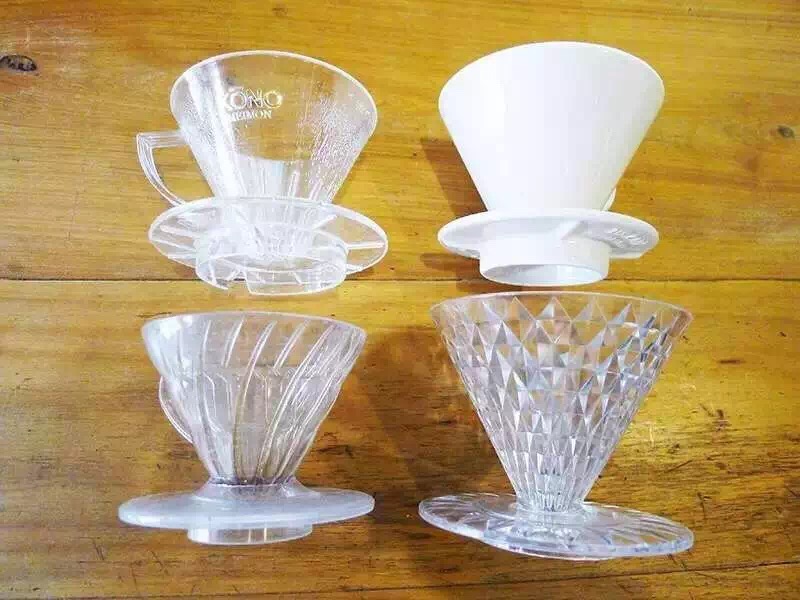
(Top left: KONO, top right: UN café, bottom left: hario V60-01, bottom right: Key Coffee diamond pattern dripper)
I've long wanted to carefully compare the differences between various drippers. At first we planned to compare every dripper, but given how different they are, it seemed forced to put them all into the same brewing environment. So we decided to compare cone-shaped drippers only. The operator for this experiment was Xiao Hei from our shop. For all four drippers we used the same brewing method, the same time and water volume for blooming, and finished brewing with the same total water volume. As always, we did our best to keep each experimental group consistent, and to get accurate results we repeated each dripper experiment three times to gather the most stable data for analysis, since everyone knows pour-over coffee has many variables.
Experimental Equipment and Materials
Coffee Beans: Nicaragua Tianyi Estate Washed Process, Medium Roast
Grinder: Baratza Forte-BG, Grind size 4T
Cone-shaped Drippers: Hario V60-01, Kono, Key Coffee Diamond Pattern Dripper, UN Café Cone Dripper (one each)
Filter Paper: Kono MD-25 (for 1-2 servings)
Experimental Procedure:
• Prepare pour-over equipment, heat water, weigh 12g (W1) coffee beans and grind for later use
• Rinse filter paper, add ground coffee to dripper, gently shake dripper to level coffee bed surface. When water temperature drops to 90°C, pour 50g water for 30s bloom
• After 30s bloom, pour 50g water in circular motion, pause until water level in dripper drops. At 1min brewing time, pour remaining 100g water in circular motion again. Record water pouring completion time as T1, and dripper removal time as T2. Weigh resulting coffee liquid weight as W2
• Brew one serving with each dripper for comparative tasting
• After coffee liquid naturally cools to room temperature, measure TDS value. Repeat operation three times and calculate average, then calculate extraction yield (Ext.)
• Repeat above steps to collect three sets of data
(50g water for 30s bloom)
(Total water volume 200g)
(Net weight of coffee liquid)
Data Recording and Results Analysis:
Ext(%) = W2 * TDS(%) / W1
In terms of concentration and extraction yield, the differences between cone-shaped dripper models are actually quite small. Concentration differences on the order of 0.01% are almost impossible to detect in a blind tasting.
In sensory terms, though, each dripper's brewing effect differs noticeably. Kono shows the most prominent acidity of the four, while UN Café's cone dripper has the weakest acidity. UN Café has the strongest sweetness, while V60 has the weakest. For the most prominent sensory characteristic of each dripper, see the rightmost column of the table.
The final results were actually quite surprising to everyone. If extraction yield is your only concern, you can now pick any of these four drippers, since they hardly differ on that measure. The remarkable thing is precisely this: despite similar extraction yields, each dripper produces very different sensory results. You can examine the experiment table above closely. Because sensory perception is hard to pin down, we decided to set aside flavor descriptions of the beans and provide simpler descriptions instead. In the end we approached it from three angles, acidity, sweetness, and body, with three people writing down their sensory impressions, then ranking and filtering them to arrive at the final sensory evaluation. If possible, we still recommend that anyone interested try it themselves and use their own senses to experience the differences between these four drippers.
Finally, we must thank operator Xiao Hei for brewing 12 groups of coffee, and data recorder Old Lin for staying after work to keep testing concentration and extraction yield. Thank you all for drinking right through until evening. You're the best.
FrontStreet Coffee Recommendation
The experiment above shows that the dripper changes how a coffee tastes, but the beans matter just as much. The V60 rewards coffees with bright, layered aromatics, and FrontStreet Coffee has plenty of them, from the classic Yirgacheffe Gudingding with its jasmine and citrus, to the tropical-fruit Huakui, the rose-and-grape Strawberry Candy, and the raisin-toned Mozart.
If you lean toward a deeper, fuller cup instead, the PWN Golden Mandheling, the Brazil Queen Estate, and the Jamaica Blue Mountain No. 1 all show beautifully in a cone dripper as well. Whichever you choose, grind medium and keep the water between 90 and 92°C to bring the best out of the brew.
Important Notice :
FrontStreet Coffee is a long-established specialty coffee roaster in Guangzhou China, selling freshly roasted beans from its own farm in Yunnan as well as dozens of carefully selected single-origin beans from around the world for both pour-over and espresso. The products deliver consistently excellent quality and great value, with shipping within 24 hours. Guangzhou's FrontStreet Coffee shop is recommended by many coffee lovers, and the beans are now available online at the Tmall 。
FrontStreet Coffee has moved to a new address:
FrontStreet Coffee Address: 315,Donghua East Road,GuangZhou
Tel:020 38364473
 Scan and follow the En Gafei WeChat official account. Please indicate that the reprint comes from "En Gafei".