Will Arabica Coffee Bean Prices Continue to Rise This Year? Latest Arabica Coffee Prices
Pandemic logistics have squeezed coffee shipping, growers' costs have climbed, and as specialty coffee goes mainstream, demand for quality beans keeps growing. Add it all up and Arabica prices have nowhere to go but up. Per International Coffee Organization data, Arabica prices rose again in January, whether that trend holds through the year remains to be seen.
Arabica Prices Keep Climbing in 2021
The ICO composite indicator prices for all groups of Arabica beans closed January 0.9% above December 2020, averaging 115.73 US cents per pound, with momentum pointing further up. Whether February would extend the run depended on the full month's data.
Robusta Prices Slip
Robusta, meanwhile, actually fell, roughly 1.8%, to an average of 70.71 US cents per pound.
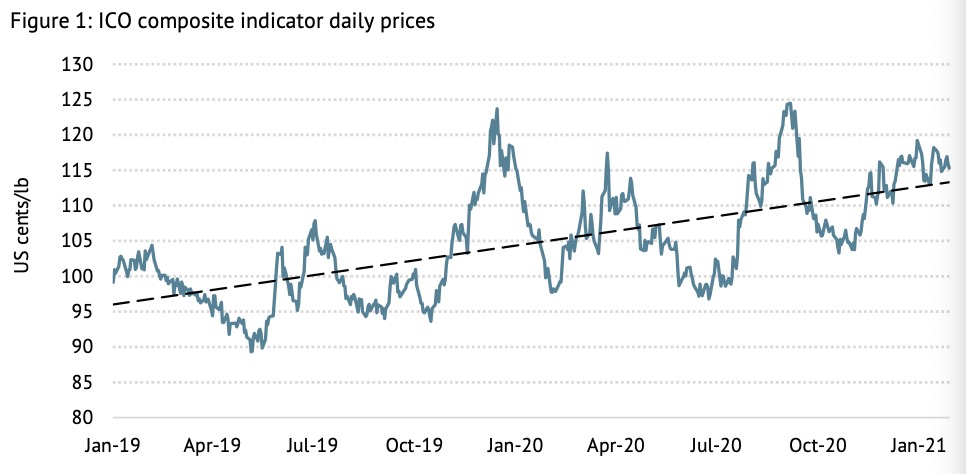
What the ICO Trend Chart Shows, 2019–January 2021
The chart tells the story clearly. From 2019 into January 2021, Arabica prices trended steadily higher. Even during the worst of the pandemic overseas (April–July 2020), when prices sank, the dip was temporary: as online shopping took up the slack and conditions eased in some regions, prices climbed sharply from July through October 2020, and despite wobbles along the way the overall trend stayed firm. Measured against 2019 levels, the trajectory is unmistakably upward, in line with ICO forecasts.
One nuance from the same data: coffee exports over the first three months of the 2021 coffee year reached 31.59 million bags, up 6.1% versus October–December 2019, evidence that Robusta demand is substantial. But with flavor that can't match Arabica and thinner margins, Robusta's production and price still trail far behind.
The 2021 Global Production Outlook
The ICO expects global coffee production to grow 1.9% in 2021, reaching 171.9 million bags, Arabica output up 5.2% to 101.88 million bags.
On the consumption side, restrictions on outdoor activity have hit cafe sales hard, yet new consumption patterns have filled the gap. Online buying, in particular, has become mainstream abroad and is helping the global economy recover slowly. The ICO accordingly forecasts 2021 consumption up 1.3% on 2020, at 166.63 million bags.
Even so, the organization projects a total production surplus of about 5.27 million bags. Data is data, though, not destiny, everything depends on how the year unfolds. COVID-19 vaccines were in development and rollout at the time; if they succeeded, the pandemic's grip could loosen and the global economy begin to recover.
*Image source: Internet
FrontStreet Coffee Recommendation
Coffee comes down to three botanical species, Arabica, Robusta, and Liberica. Robusta is punchy and crema-rich, the workhorse of espresso blends and instant coffee; Liberica has so little commercial value that only small research lots survive. Nearly everything on the specialty shelf is Arabica, whose quality and site-specific character explain the explosion of single origins. Here are FrontStreet Coffee's most popular Arabica lots:
- FrontStreet Huakui, Ethiopian landrace (Heirloom) trees of mixed, unsorted varieties, so bean sizes vary. Natural-processed, with delicate florals and vivid fruit: creamy strawberry, mango, jackfruit, citrus, blueberry, the ripe tropical-fruit signature of Sidamo naturals. The same fragrant berry character won first place in that year's TOH green coffee competition, and the price-to-quality ratio is hard to beat.
- FrontStreet Yirgacheffe Guji Dingding Cooperative, the washed counterpart to Huakui. Yirgacheffe's clean, luminous lemon and citrus tones are specialty Arabica royalty, and the town's surrounding villages each run their own washing stations; Dingding village's is the Dingding Cooperative. Top Ethiopian grade G1, classic washed: elegant white florals, citrus, orange, and green tea.
- FrontStreet Jamaica Blue Mountain No.1, yes, it's Typica, one of Arabica's founding varieties, the one first carried from Yemen to India, Indonesia, and the Americas. Typica is balanced, mild, and smooth, with soft acidity and pure aromatics, but disease-prone and low-yielding. Blue Mountain's Typica arrived from Martinique in the 1820s and, over two centuries, evolved better resistance, notably to berry blotch. Transplant it out of Jamaica, though, and it loses that clean, delicate sweetness; in FrontStreet's cuppings, no other origin comes close to its balance.
- FrontStreet Panama Red Label Geisha, the variety that swept the world: rich florals, citrus, peach, and layered fruit acidity with a silky, cream-like texture and an oolong-tea sweetness on the finish, closer to a fragrant fruit tea than coffee. Geisha yields little and the trees are fragile and fussy. The Red Label lot comes from Panama's most famous farm, Esmeralda, in Boquete, Chiriquí, volcanic soil, old forest, near-permanent mist, and abundant rain make the growing conditions exceptional.
- FrontStreet Brazil Queen Estate, Bourbon, Typica's fellow heirloom, named for the island of Réunion (le Bourbon). Bourbon trees have broader leaves, grow densely, and out-yield Typica by 30%; the beans are round and short. Red cherries are the norm, but mutations abound, including the orange-yellow Yellow Bourbon, which Queen Estate was among the first to cultivate. Expect cream, peanut, toasted bread, and sugarcane, full and sweet, across pour-over, moka pot, or espresso.
- FrontStreet Colombia Sidra, originally from Pichincha, Ecuador (locally "Sydra"); genetic comparisons link it to Ethiopian landraces, leading some researchers to think it's a cross between an Ethiopian experimental variety and local Bourbon. When champion barista Anthony Douglas used Sidra from the Borderlands (Frontera) estate at the 2022 World Barista Championship, the variety took off. FrontStreet's medium-light roast shows florals, tropical fruit, grape, dried fruit, and passion fruit with a juicy mouthfeel.
Important Notice :
FrontStreet Coffee is a long-established specialty coffee roaster in Guangzhou China, selling freshly roasted beans from its own farm in Yunnan as well as dozens of carefully selected single-origin beans from around the world for both pour-over and espresso. The products deliver consistently excellent quality and great value, with shipping within 24 hours. Guangzhou's FrontStreet Coffee shop is recommended by many coffee lovers, and the beans are now available online at the Tmall 。
FrontStreet Coffee has moved to a new address:
FrontStreet Coffee Address: 315,Donghua East Road,GuangZhou
Tel:020 38364473
 Scan and follow the En Gafei WeChat official account. Please indicate that the reprint comes from "En Gafei".