
Is Turkish Coffee Fortune Telling Accurate?! How to Read Turkish Coffee Ground Patterns
Today's younger generation may verbally reject superstition, but their actions say otherwise. From blessing rituals to tarot readings and online horoscopes, they eagerly seek glimpses of the future — wondering when love might arrive or a windfall might land. Among all these practices, one activity satisfies both their coffee habit and their appetite for divination.
A Turkish coffee shop called JoJo's, located in Shenzhen's Nanshan District, has rapidly gone viral on social media for offering coffee fortune-telling. Who would have thought that while the older generation heads to temples to draw fortune sticks, the younger crowd now lines up at coffee shops to consult their destiny?

The Cultural Heritage of Turkish Coffee
Turkish coffee is rich and intense, and it has never been a mainstream style — yet that hasn't stopped young people from making pilgrimages to Turkish coffee shops, all in the name of divination. Fortune-telling runs deep in the region. Before Islam arrived, the people there practiced Shamanism, which is how divination culture first entered Turkish society.
Coffee's introduction was religious as well. Sufi Muslims drank coffee during nighttime prayer ceremonies to fight off sleep. Once people caught on to coffee's power against drowsiness, drinking it quickly spread. As the Arab Empire declined, the Ottoman Empire to the north rose as the new leader of the Arab world. After conquering Egypt and vast stretches of East Africa, the habit of coffee drinking arrived in Ottoman hands.
When the first coffeehouse opened in Istanbul around 1555, coffee houses and coffee culture soon became defining markers of social life. Thanks to Istanbul's unique position as a crossroads, the city drew merchants and travelers from everywhere — and it was through them that Europeans discovered coffee, which then spread across the world.
The Birth of Coffee Divination
With Turkey's long-standing divination culture and its flourishing coffee culture, coffee divination was almost inevitable. The practice spread across the former territories of the Ottoman Empire and first appeared in the Ottoman palace in the 16th century. Palace concubines, often bored with daily palace routine, would drink coffee, read each other's fortunes, and trade gossip.
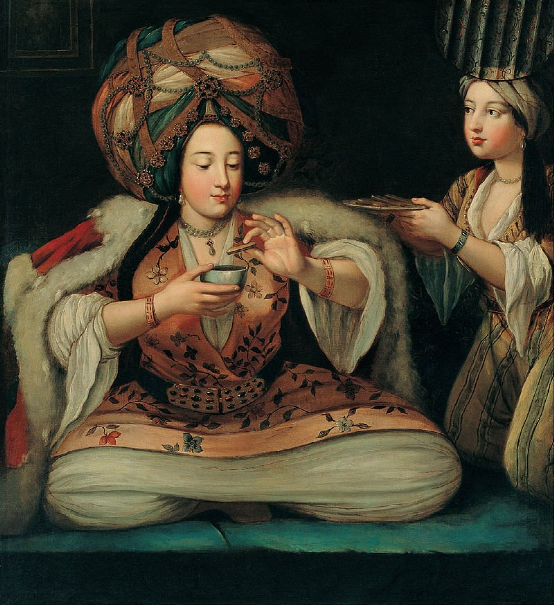
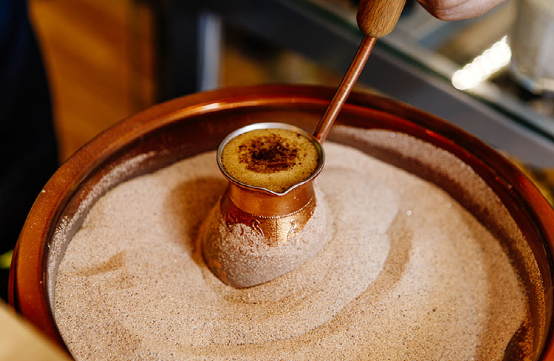
Coffee has come a long way — from whole cherries boiled in water, to chewed outright, to ground powder for brewing, and finally to today's filtered methods. Coffee grounds, dismissed by most modern drinkers, were once the "sands of time" used to foretell fortune and misfortune. Recreating Turkish coffee divination at home isn't hard — all you need is a Turkish coffee pot to enjoy a rich, robust cup.
Add cold water and coffee powder to the copper pot, then set it over heat. As the liquid boils, the coffee throws up a thick foam that keeps rising until it nearly overflows. At that point, pour a little of the coffee into a cup, return the pot to the heat, and repeat the process several times.
Turkish coffee's flavor is bold and heavy, and not everyone takes to it. As you drink down to the bottom of the cup, you'll clearly feel the grounds. Then cover the cup with its saucer, swirl it horizontally in three circles, and flip it over. Place a ring or a coin on top and let it rest for 5 to 10 minutes. Once the cup has cooled completely, lift it and read the patterns the grounds have left behind.
How to Read Coffee Grounds
Coffee divination involves interpreting two parts: the saucer and the cup.
The Saucer
A large clump of grounds falling onto the saucer means your worries will soon disappear; grounds forming a strip-like channel on the saucer signal wealth heading your way; and if, when you lift the cup, the grounds on its walls connect with those on the saucer, your wishes will come true.
The Cup
The cup itself can be divided in several ways. Some read it vertically — bottom, middle, and top — as past, present, and future. More commonly it's split into five zones: the handle side, front, top, lower side, and bottom. The handle side concerns your emotional life, the front your finances, the bottom your family affairs, the top your present life, and the lower side your future.
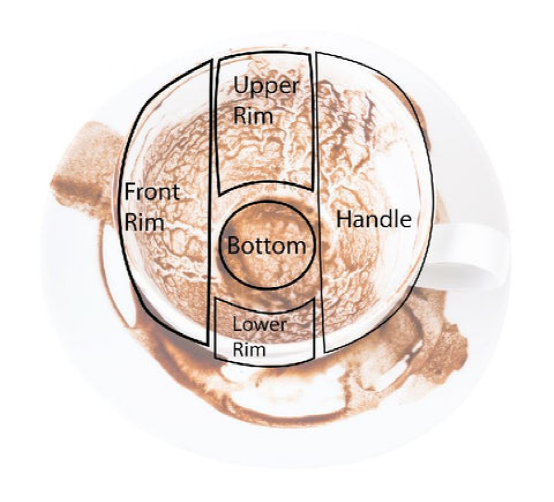
Within each zone, observe the specific shapes left by grounds sliding down the cup wall. Different patterns carry different meanings: an angel signals good news, an arrow bad news, a heart love, a cat or fox betrayal by someone close, an apple longevity, and a snake an ominous sign — among many others.
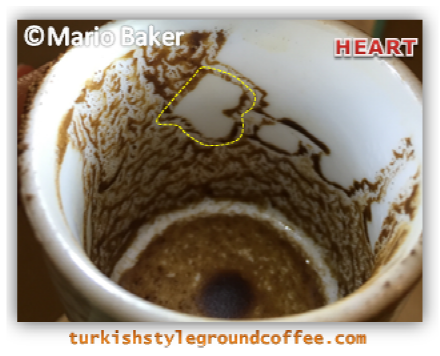
Plenty of young people turn to Turkish coffee divination hoping to peek at their future. In many cases, what it really offers is comfort during uncertain times. The generation that once told its elders to abandon feudal superstitions now enthusiastically embraces coffee-ground readings — proof that the wheel of fortune truly turns.
Image source: Internet
FrontStreet Coffee Recommendation
Ethiopia: FrontStreet Natural Guji Huakui, FrontStreet Washed Guodingding Cooperative. Ethiopia is Africa's largest coffee-producing country and the widely recognized birthplace of coffee, home to an enormous range of varieties — most beans are named after their region or cooperative. The most famous regions are Yirgacheffe and Sidama. In the 1970s, to improve green coffee quality, the government introduced washed processing, and since then Yirgacheffe beans have been predominantly washed, with production further organized around individual processing cooperatives. FrontStreet's washed Guodingding Cooperative lot is a classic Yirgacheffe expression: jasmine florals, lemony acidity, and berry notes. Sidama beans, by contrast, are best known as naturals, with more pronounced tropical fruit and fermented aromas — FrontStreet's Sidama Huakui uses traditional natural processing, with flavors of berries, florals, jackfruit, melon, and honey.
Brazil: FrontStreet Cerrado Red Bourbon, FrontStreet Queen Estate. Brazil is the world's number-one coffee producer, and while most of its output is commercial grade, plenty of high-quality Brazilian coffee exists. Because Brazilian farms largely use sun-exposed planting, the cherries ripen quickly, giving a softer bean with gentle acidity, excellent sweetness, a delicate and smooth entry, and an overall balanced cup. FrontStreet's Brazil everyday bean is an entry-level single origin from the famous Cerrado region — the definition of great taste at a great price, with classic cream, peanut, and cocoa flavors in the cup. FrontStreet's Queen Estate is grown at higher elevation and carries the rare Yellow Bourbon variety: alongside the buttery, nutty (macadamia, almond) complexity typical of Brazil, it offers a sugarcane-like sweetness and a viscous, silky mouthfeel whether brewed black or with milk.
Indonesia: FrontStreet Lintong Mandheling, FrontStreet PWN Golden Mandheling. Indonesia is famous for more than just Kopi Luwak — its Mandheling is equally iconic. FrontStreet's Mandheling uses the wet-hulled (giling basah) process, a technique born of local conditions: unpredictable rain and limited resources mean producers strip the parchment off semi-dried beans by machine to speed up drying, creating the one-of-a-kind Mandheling profile. The result is a cup even richer and smoother than FrontStreet's Blue Mountain, with herbal and spice notes — ideal for anyone who dislikes acidity. If you want a higher grade, choose FrontStreet PWN Golden Mandheling: it passes through three rounds of hand-sorting plus one machine-sorting to drive the defect rate down to a minimum, producing a cleaner, smoother cup with clearer woody aromatics and caramel sweetness.
Colombia: FrontStreet Huila, FrontStreet Sidra, FrontStreet Big Navel. Colombian coffee is one of the few single origins sold under a country's name. The climate is mild and humid, and its diversity keeps Colombia in harvest mode all year as different varieties and regions ripen in turn. The coffee is distinctive — full-bodied with a long finish — and largely qualifies as specialty. FrontStreet's everyday Colombian comes from Huila, the country's most renowned specialty region: ringed by mountains, planted at elevations above 1,500 meters, and fed by the confluence of Colombia's most important rivers, which bring abundant moisture and water resources. Colombian coffee tends toward soft florals and gentle fruit acidity — try FrontStreet Colombia Sidra or FrontStreet Colombia Big Navel.
Costa Rica: FrontStreet Mozart, FrontStreet Blackberry, FrontStreet Tarrazu. Costa Rica grows coffee at high elevations with large day-night temperature swings and rich volcanic soil everywhere, producing strictly hard beans (SHB grade) full of elegant aromatics. The country is best known for honey processing: the beans dry with their mucilage still attached, giving intense sweetness and clarity of flavor — especially appealing to many women drinkers. For Costa Rican specialty coffee, start with FrontStreet Blackberry (black honey process) or FrontStreet Mozart (raisin honey process): expect raisin and blueberry sweetness with osmanthus and rose fragrance, and a bright sweetness that shines in pour-over, cold brew, Americano, or latte.
Yunnan, China: FrontStreet Yunnan Catimor, FrontStreet 2013 Yunnan Typica. No specialty coffee conversation is complete without China's own origin. Yunnan coffee has steadily entered the spotlight, and many drinkers have fallen for its nut, brown sugar, and black tea notes. China actually has two growing regions — Hainan and Yunnan — but Hainan's hot, low-elevation coastal climate can't support Arabica. China's specialty coffee is concentrated in Yunnan. FrontStreet's Yunnan everyday bean comes from Baoshan and is washed, delivering classic nut and chocolate flavors in a soft, balanced cup; FrontStreet's 2013 Yunnan Typica is an ancient Arabica variety grown at 1,300 meters, with a cleaner cup that suits medium roasting — expect layered aromas of hazelnut, dried apricot, black tea, caramel, and ripe plum.
Panama: FrontStreet Boquete Washed Geisha. Panama is famous above all for the Geisha variety, and none more so than Hacienda Esmeralda — citrus, berries, and florals in a balanced, silky cup, like an entirely non-bitter floral fruit tea. But for beginners, Esmeralda can be a stretch, so baristas recommend the entry-level FrontStreet Boquete Geisha. It comes from Panama's most representative specialty region with pure Geisha genetics and is washed processed, so you can clearly taste the orange-blossom sweetness and honeyed finish that define Geisha — and at such a strong price-to-quality ratio, you can explore Panama Geisha through many different brewing methods.
Important Notice :
FrontStreet Coffee is a long-established specialty coffee roaster in Guangzhou China, selling freshly roasted beans from its own farm in Yunnan as well as dozens of carefully selected single-origin beans from around the world for both pour-over and espresso. The products deliver consistently excellent quality and great value, with shipping within 24 hours. Guangzhou's FrontStreet Coffee shop is recommended by many coffee lovers, and the beans are now available online at the Tmall 。
FrontStreet Coffee has moved to a new address:
FrontStreet Coffee Address: 315,Donghua East Road,GuangZhou
Tel:020 38364473
 Scan and follow the En Gafei WeChat official account. Please indicate that the reprint comes from "En Gafei".

