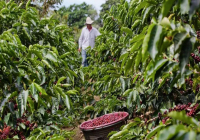
What are the characteristics of Ethiopian Sidamo coffee? Introduction to coffee from Alo village, Bensa area
The Story of Sidamo: Ethiopia's Renowned Coffee Region
Ethiopia is home to many renowned coffee regions, among them Sidamo, Yirgacheffe, Guji and Kaffa, all of which are fairly common on the market today. But what characterizes Sidamo, and why do some people call it Sidama?

The Historical Evolution from Sidama to Sidamo
The region was originally called Sidama, and it lies in southern Ethiopia. In the late 19th century, the Ethiopian imperial court invaded and annexed the area, referring to it as Sidamo at the time. Coffee produced there consequently came to be called Sidamo coffee, gradually earning recognition for its distinctive aroma and flavor. Only later, when the government reorganized various ethnic groups and regions, was the area incorporated into the Southern Nations, Nationalities, and Peoples' Region and its name corrected to Sidama.
Compared with Sidama, though, people are simply more used to saying Sidamo. When the Ethiopian government moved to protect the region's coffee, it even chose Sidamo® as the registered trademark, which is why people still habitually call the area "Sidamo" to this day.

Sidamo's Geographic and Climatic Advantages
Before 2020, Sidamo was merely a zone within the Southern Nations, Nationalities, and Peoples' Region. Then a local independence referendum turned it into the Sidama Region.
The Sidamo region sits on the plateau south of Lake Awasa in the East African Rift Valley. The area has diverse microclimates, abundant rainfall that reaches 2000 millimeters a year, and fertile, well-draining volcanic soil. Coffee is grown at elevations between 1400 and 2200 meters, an ideal environment for cultivation.

Bensa: The Rising Star of Sidamo
Sidamo also contains several well-known sub-regions, such as Bensa and Arbegona. In recent times, Bensa has gradually risen to prominence. Located in the northeastern part of Sidamo, Bensa has notably high elevations, ranging from 1800 to 2300 meters, with some areas cultivating coffee as high as 2400 meters.
FrontStreet Coffee has often noted in previous articles that higher altitudes create greater temperature swings between day and night. During the cooler periods, the maturation of the coffee cherries is extended, allowing sugar compounds to accumulate. The result is denser beans and more developed flavor.

Alo Coffee: Bensa's Premium Producer
Today the most renowned name in the Bensa area is Alo Coffee. Alo Coffee PLC is both an Ethiopian coffee trading company and a green coffee brand. A relatively new company established only 4 years ago, it was founded by Tamiru Tadesse Tesema and primarily handles the export of coffee from the Bensa region.
Tamiru was born in Alo village in the Bensa region and studied engineering, but always wanted to work in coffee. When he saw a friend, also from Bensa, win a Cup of Excellence award for their coffee, it sparked his interest. Recognizing Bensa's tremendous potential, he set up a company dedicated to promoting coffee from the region.

Alo's Processing Network and Quality Commitment
He began by establishing a processing station in Alo village to collect and process beans from about 200 nearby coffee farmers, giving them professional training in cultivation. He also took responsibility for beans produced in the surrounding villages. Today ALO has established 8 processing plants in the region, all located near coffee farming communities. That placement allows for faster processing immediately after harvest, ensuring freshness and quality. The varieties ALO produces mainly come from the JARC (Jimma Agricultural Research Center) 74 series, including 74158, 74165, 7412 and 74110.
FrontStreet Coffee has also acquired ALO coffee, selecting beans from Alo Coffee's Hatessa processing plant. Using the 74158 variety with natural processing, it brews with subtle magnolia floral notes and a slight fermented character. The cup reveals citrus, passion fruit, pineapple and other tropical fruit flavors with a refreshing mouthfeel.


FrontStreet Coffee Recommendation
Sidamo and Yirgacheffe are neighbors in southern Ethiopia, and if you enjoy the floral, citrus-driven character of this part of the country, FrontStreet's washed Yirgacheffe is the classic entry point. The town of Yirgacheffe sits in the Sidama zone at roughly 1,700 to 2,100 meters, with coffee planted above 1,800 meters, and the cup shows white jasmine, bright citrus and lemon acidity with a tea-like body, all at a very approachable price.
To taste how a village-level lot changes that profile, FrontStreet's Guodingding cooperative coffee comes from the Worka area at the southeastern edge of Yirgacheffe. Originally part of the Worka cooperative under the Yirgacheffe Coffee Farmers Cooperative Union, it was later identified as a "single origin" in its own right. It follows the most traditional washed processing, and the cup has none of the usual bitterness, carrying clean, bright citrus and lemon acidity and jasmine fragrance that wins people over at the first sip.
For a natural, fruit-forward take on the same region, FrontStreet's Natural Red Cherry is made from fully ripe cherries alone. After sorting at the station the cherries dry on raised beds, turned every 2 to 3 hours during the first few days to prevent uneven heat and over-fermentation. After three to five weeks the dried fruit is scraped off by machine and the beans are stored. Because the cherry dries with the fruit still on, the cup keeps the typical Yirgacheffe character while adding tropical fruit, showing citrus acidity, a berry-juice texture, honeyed sweetness and a creamy smoothness.
Important Notice :
FrontStreet Coffee is a long-established specialty coffee roaster in Guangzhou China, selling freshly roasted beans from its own farm in Yunnan as well as dozens of carefully selected single-origin beans from around the world for both pour-over and espresso. The products deliver consistently excellent quality and great value, with shipping within 24 hours. Guangzhou's FrontStreet Coffee shop is recommended by many coffee lovers, and the beans are now available online at the Tmall 。
FrontStreet Coffee has moved to a new address:
FrontStreet Coffee Address: 315,Donghua East Road,GuangZhou
Tel:020 38364473
 Scan and follow the En Gafei WeChat official account. Please indicate that the reprint comes from "En Gafei".