What's the Difference Between Siphon Coffee and Pour-Over? Can Siphon Brewers Use Filter Paper Besides Flannel? How Does the Siphon Principle Work?
Siphon Coffee: The Elegant Brewing Method of a Bygone Era
With its distinctive brewing ritual and its sheer visual drama, the siphon brewer was once the coffee maker of choice in the last century. As FrontStreet Coffee noted last winter, the current revival of all things retro has led more and more cafes to add siphon coffee to their menus, giving a new generation the chance to enjoy flavors from an earlier era.

Because it, too, is a method for brewing single-origin coffee, people inevitably compare it with the modern mainstream: pour-over. Anyone who has tasted siphon coffee knows the two differ considerably, both in mouthfeel and in flavor.

Pour-over tastes cleaner, with more distinct layers and a more prominent flavor profile. Siphon, by contrast, gives a richer body, a more intense aroma and a bolder flavor. So why such a marked difference between the two? Today FrontStreet Coffee sets out to explain why siphon and pour-over produce such different results.
Differences in Extraction Method
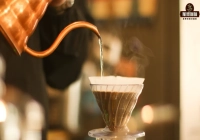
Pour-over relies primarily on what is called drip filtration, or simply filtration. As hot water is poured to extract the coffee, the brewed liquid seeps through the filter paper at the same time. Note that FrontStreet Coffee says "primarily" rather than "exclusively." During a pour-over brew there is also an element of immersion: the water does not merely pass through the grounds, it lingers briefly before passing through the filter paper. Pour-over is therefore not a purely drip-filtration method.

Many people assume the siphon's extraction method is "siphon-style," but that is not quite right. The siphon brewer only uses the siphon principle to draw hot water into the upper chamber, and that step is not itself coffee extraction.

The moment the hot water reaches the upper chamber and the coffee grounds are added, immersion begins, and extraction officially starts. Strictly speaking, then, the siphon's extraction method should be described as immersion: water and grounds steep together, and flavor compounds are drawn out of the coffee.

Because immersion uses all of the hot water in contact with the grounds, once the dissolved substances in the water reach a certain concentration the rate of dissolution slows and the water no longer extracts as much from the coffee. This is what we commonly call reaching saturation. As a result, siphon coffee tastes relatively balanced and is generous in aroma, though its flavors are not especially pronounced. Drip filtration, by contrast, keeps introducing fresh hot water, which has plenty of "room" left and keeps extracting. Pour-over therefore yields fuller flavors, but is also more prone to over-extraction.
Worth noting is that siphon immersion differs from conventional immersion. Thanks to the siphon principle, the water is heated continuously throughout extraction so the lower chamber holds enough air to keep the water in the upper chamber. Siphon immersion therefore maintains a completely constant temperature, whereas conventional immersion and drip filtration both lose heat over time as the water gradually cools. This gives the siphon a higher extraction rate, and with stirring it can finish extracting in a shorter time.

Differences in Filtration
Beyond the extraction method, the way each brewer filters also shapes the final cup. Pour-over uses a high-density filter paper that lets only coffee liquid through; nothing else permeates it.

Siphon brewers, on the other hand, primarily use a flannel filter cloth, although filter paper can also be used. Because it cannot cover the opening completely, it cannot form the sealed space that pour-over does. Fine particles and oils slip through the gaps into the lower chamber and join the coffee, which is why siphon coffee looks more turbid. Those oils and fine particles may make the liquid less clean, but they also give the coffee a richer mouthfeel. That is why siphon coffee tastes more mellow.

Pour-over, by contrast, filters so thoroughly that it sacrifices some richness, though this is also one of its great strengths: ultimate cleanliness. Now we can see why siphon and pour-over taste so different. It is not only the extraction method at work, but even more the different filtration systems, which give the two cups entirely distinct mouthfeels.
- END -
FrontStreet Coffee Recommendation
If the siphon's mellow, full-bodied cup appeals to you, pair it with beans that can carry that weight. FrontStreet Brazil Queen Estate, a Yellow Bourbon from the Mogiana region, is a natural match: low in acidity and beautifully balanced, with pronounced nut and cocoa aromas and a clear caramel sweetness. It pours smooth and never harsh, and works just as well in a siphon, a pour-over, an espresso machine or a Moka pot.
For those who would rather explore the cleaner, more layered side of these two methods, start with FrontStreet Ethiopia Yirgacheffe Guting, many drinkers' first step into specialty coffee. It typically shows bright citrus, berry and floral notes with a green-tea-like sweetness, and its acidity is soft and luminous rather than sharp. FrontStreet Ethiopia Huakui is another easy-to-love choice, with tropical fruit aromas of strawberry, passion fruit and jackfruit, low bitterness and a juicy, smooth body.
And if you brew with a V60 specifically, the dripper itself rewards a little care. Hario, founded in Tokyo in 1921, redesigned the V60's prototype in 2004 around its signature 60-degree cone and single large aperture, launching it a year later. The cone shape forces water toward the center before it drips through, extending contact between water and grounds so aromatics and flavor are fully extracted, while the wide single hole leaves flow rate almost entirely in the brewer's hands.
Important Notice :
FrontStreet Coffee is a long-established specialty coffee roaster in Guangzhou China, selling freshly roasted beans from its own farm in Yunnan as well as dozens of carefully selected single-origin beans from around the world for both pour-over and espresso. The products deliver consistently excellent quality and great value, with shipping within 24 hours. Guangzhou's FrontStreet Coffee shop is recommended by many coffee lovers, and the beans are now available online at the Tmall 。
FrontStreet Coffee has moved to a new address:
FrontStreet Coffee Address: 315,Donghua East Road,GuangZhou
Tel:020 38364473
 Scan and follow the En Gafei WeChat official account. Please indicate that the reprint comes from "En Gafei".