What are Kenya PB Peaberries: Flavor Differences between PB and AA Grade Kenyan Coffee Beans

Kenya AA is reliably ranked among the world's finest specialty coffees, and from those newer to Kenyan coffee, FrontStreet Coffee's baristas constantly hear the same question: what does "AA" mean? And right behind it comes the other mystery label, "PB." What do these letters stand for? If you've ever wondered, FrontStreet Coffee is here to walk you through Kenyan coffee.

In FrontStreet Coffee's bean library, AA and PB are both grade designations. The full Kenyan grade list runs:
- Kenya E (Elephant Beans)
- Kenya PB (Peaberry)
- Kenya AA
- Kenya AB
- Kenya C
- Kenya TT
- Kenya T
- Kenya MH/ML
Coffee is graded before roasting, and Kenya grades by green bean size. The point is roast consistency: beans of similar size roast at similar speeds, while mixed sizes roast unevenly — small beans over-roasting while large ones stay under-done.

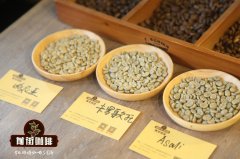
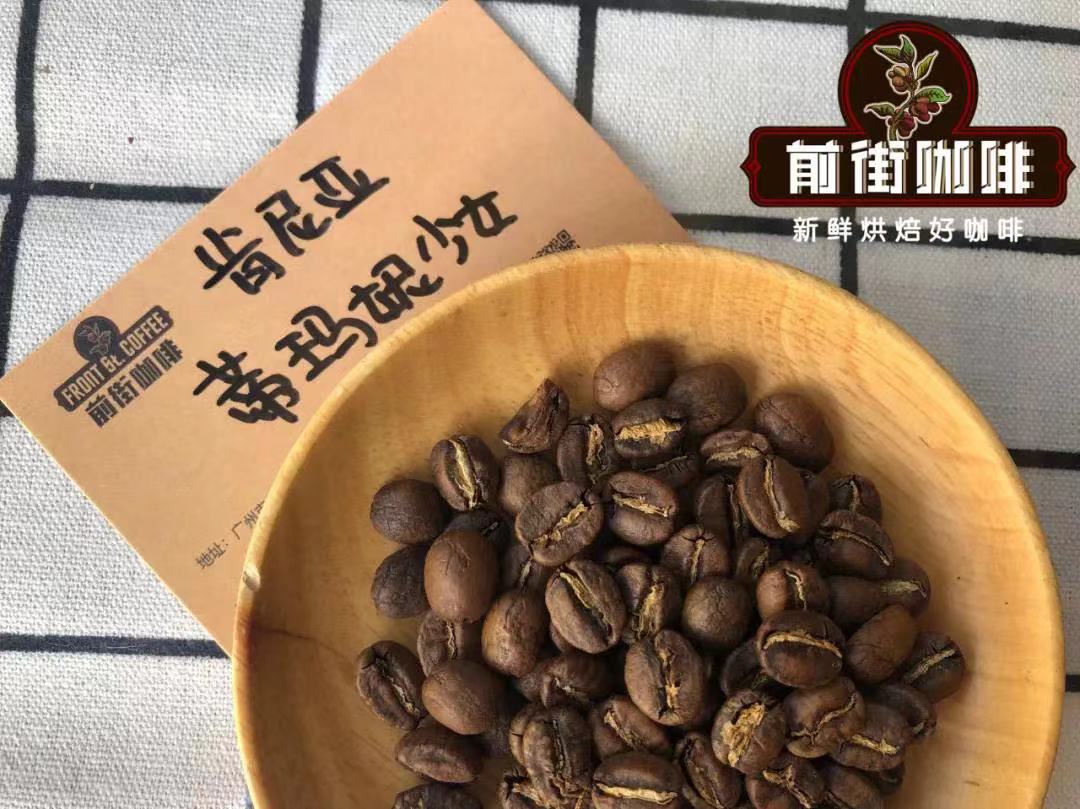
FrontStreet Coffee explains each grade in turn. Kenya E — "Elephant" grade — is the largest bean size. Kenya PB is the peaberry, or round bean: a coffee cherry normally holds two half-beans, but a peaberry cherry contains just one whole round bean. It is a rarity — only about 5% of Kenyan beans are peaberries — and many drinkers believe peaberries carry better flavor than their flat-sided siblings. Kenya AA, meanwhile, grows above roughly 6,600 feet and measures 18 screen.
Kenya AB measures 16 screen and is literally a mix: Grade A beans sieved at 6.8 mm plus Grade B beans sieved at 6.2 mm, blended into one grade. Grade C runs about 15 screen. Kenya TT is low-density coffee floated off from AA, AB, and E by air aspiration; Kenya T is the broken, defective, and undersized remainder; and MH/ML marks unripe beans. So how do AA and PB actually differ in the cup? FrontStreet Coffee digs into that below.

The Kenyan Grading System at a Glance
That is FrontStreet Coffee's summary of the system. To bring Kenya PB to life, FrontStreet Coffee is profiling a peaberry lot acquired some time ago. The green bean details:
Kenya Nyeri Ichamama Pearl Peaberry
- Country: Kenya
- Region: Nyeri, Karima Village
- Processing Station: Ichamama
- Producer: Othaya Farmers' Cooperative Society member smallholders
- Altitude: 1,700–1,750 meters
- Varieties: SL28 / SL34
- Soil: Volcanic soil
- Temperature: 18–26ºC
- Harvest Season: November–January
- Processing Method: Water selection, washed, African raised-bed sun drying
Kenya sits in eastern Africa, next door to Ethiopia, coffee's birthplace. Its producers fall into two broad camps — large estates and smallholders — but either way the processed beans go to the official Coffee Board for grading and auction: the Board circulates samples of upcoming lots to registered buyers and auctions them every Tuesday in Nairobi (the NCE bidding session).
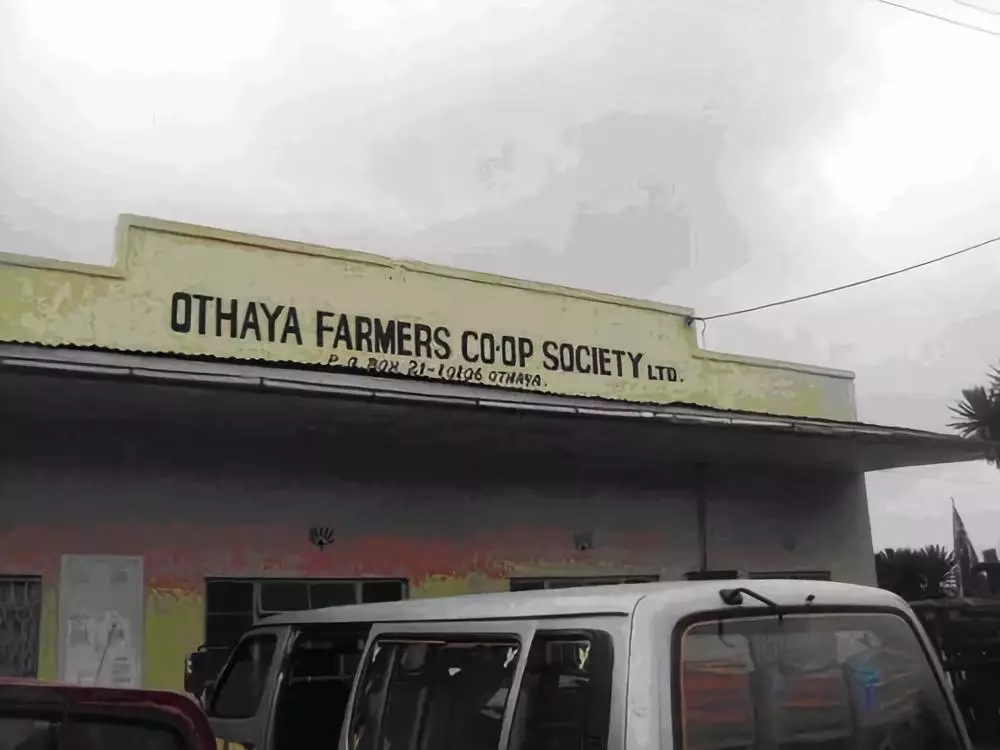
The peaberry FrontStreet Coffee acquired came from the Othaya Farmers' Cooperative Society in Othaya town, Nyeri, in Kenya's central highlands about 120 kilometers north of Nairobi. It is Kenya's largest coffee-farmer organization, almost entirely self-organized and run by smallholders, and holds Fair Trade certification. Othaya's stated vision is to be Kenya's best-managed cooperative — producing the highest quality coffee, selling it at the best prices, and giving every member farmer a better life.
The cooperative operates 19 washing stations, including Kamoini, Gatugi, and Ichamama. Founded in 1956, it now counts about 14,000 members. To lift yields and quality, Othaya applies for World Bank grants to hire agronomy and harvest-training consultants, and runs its own nursery and laboratory, developing new varieties (Batian, for example) for planting trials. It holds its own cultivation and marketing licenses, letting it trade directly with international markets, and it belongs to the Kenya Cooperative Coffee Exporters (KCCE), so it can export directly under KCCE's name without going through the NCE auction.

The Ichamama station lies in Karuthi, Nyeri, with 310 hectares under cultivation worked by 927 farmers in rich red volcanic soil beside the Ichamama River, which supplies excellent fresh water. Tea grows here as well. The altitude is extreme — over 1800 meters — and cool nights slow the cherries' maturation, building the wonderful cup complexity that makes Kenyan coffee so famously acidic.
Roasting Approach
FrontStreet Coffee designed a roasting profile around the green bean characteristics of this coffee. The peaberry greens are emerald in color, with relatively high moisture and high density. Peaberries tumble more easily in the drum and so heat more evenly than flat beans, but the density of this particular lot slows heat transfer into the core. FrontStreet Coffee therefore extended the dehydration stage to homogenize the bean during the ramp, then entered first crack with higher heat to express its rich berry flavors and full texture.
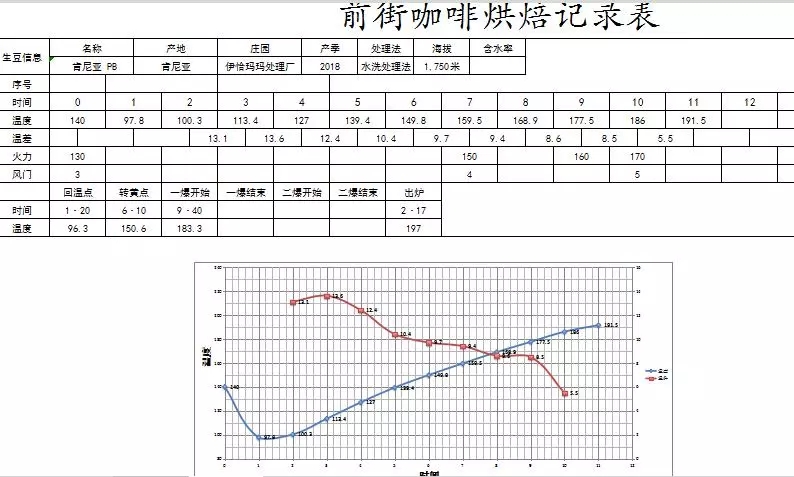
FrontStreet Coffee ran four test roasts to observe how the bean responds. The roaster found it absorbs heat very fast — the usual charge temperature pushed the turning point too high, and after first crack the ROR would crash as water vapor carried heat away. So four strategies were tried: (1) a FSSF-style roast (fast in, slow out); (2) adding heat at yellowing to drive the Maillard reaction and boost acidity; (3) adding heat at browning to drive caramelization and boost sweetness; (4) an SSFF (slow in, fast out) gradual-heat-increase roast.
Comparing the four, the gradual-heat-reduction roast left more silver skin clinging — a sign of under-development, with astringent acidic aromatics dominating. The three heat-increase roasts developed properly, filling the room with dark plum, blackcurrant, and sugarcane sweetness. Profiles 2, 3, and 4 went to the cupping table to see which best displayed the bean's character.

Cupping Results
In the cup, FrontStreet Coffee's PB shows a composed, mature aroma with hints of winey acidity: dark berries and malic acidity on the nose, a full, rich mouthfeel, sugarcane sweetness laced with cocoa. Comparing the roast methods, the longer-than-usual dehydration removed the astringency caused by uneven moisture loss, leaving a smoother, rounder cup.
That is FrontStreet Coffee's read on roasting this bean: extend the dehydration, then add heat before the browning point and again before first crack to push development. Interestingly, the pre-crack heat boost also stops the ROR from crashing and the roast from over-developing. Peaberries are unusual stock for FrontStreet Coffee, and the Ichamama Pearl Peaberry leaves a different overall impression from a typical Kenya AA — it lacks the very bright acidity and ripe-tomato aroma, running gentler instead.
FrontStreet Coffee: Head to Head with Kenya AA
Talk is cheap — so for a direct comparison, FrontStreet Coffee brewed its Kenya AA with the same parameters. First, the bean's details:
Kenya Thiman Girl AA Coffee Beans
- Region: Nyeri, Ndima-ini Processing Station
- Altitude: 1700–1900 meters
- Varieties: SL28 & SL34
- Processing Method: K72 washed
- Grade: AA

Although the K72 label implies 72 hours of fermentation, this lot actually fermented for 80 hours — which is why this washed Kenyan leans so acidic. FrontStreet Coffee's brewing recommendations:
- Dripper: V60
- Water Temperature: 90°C
- Dose: 15 g
- Ratio: 1:15
- Grind Size: Medium-fine (77% pass-through on the #20 standard sieve)

FrontStreet Coffee's extraction method: segmented pouring — bloom with 30 g of water for 30 seconds, then small-flow circular pours to 125 g; once the water level drops to just expose the coffee bed, pour to 225 g and stop; remove the dripper when the bed is exposed again (timing from the start of the bloom). Total extraction time: 2'00".

In the cup: pronounced dark berry flavors, with a charming bright sweetness at first sip that turns to grape acidity as it cools and finishes with the lively tang of plum. High layering, delicate texture, and a long aftertaste.
FrontStreet Coffee Recommendation
More Bright, Fruity Beans to Explore
If the juicy acidity of Kenyan coffee is your lane, FrontStreet Coffee's Kenya Little Tomato is an obvious next pour. From the Thika region at 1550–1750 meters, built on local SL28 and SL34 and processed by Kenya's signature 72-hour double-wash fermentation, it is lightly roasted to keep the lively acidity intact: dried-tomato and floral dry fragrance, then clear cherry-tomato and dark plum flavors with full fresh-pressed-juice body, pear and black plum accents mid-palate, and a clean finish of yellow sugar and green tea. For something gentler, the Ethiopia Yirgacheffe Worka (Gotiti) lot is the classic first step into specialty pour-over — citrus, berry, and floral notes with a green-tea-like sweetness and an acidity that reads as fruit rather than sharpness. And the Ethiopia Huakui goes even bolder: strawberry, passion fruit, jackfruit, even lychee aromatics with barely any bitterness — the "least coffee-like coffee," and a favorite of drinkers who never got along with dark, bitter cups.
Important Notice :
FrontStreet Coffee is a long-established specialty coffee roaster in Guangzhou China, selling freshly roasted beans from its own farm in Yunnan as well as dozens of carefully selected single-origin beans from around the world for both pour-over and espresso. The products deliver consistently excellent quality and great value, with shipping within 24 hours. Guangzhou's FrontStreet Coffee shop is recommended by many coffee lovers, and the beans are now available online at the Tmall 。
FrontStreet Coffee has moved to a new address:
FrontStreet Coffee Address: 315,Donghua East Road,GuangZhou
Tel:020 38364473
 Scan and follow the En Gafei WeChat official account. Please indicate that the reprint comes from "En Gafei".